Best Pokies in Melbourne: Venue Checks and Rules
 Available in AU
Location results do not confirm a gaming venue, and opening hours or payment options need separate verification.
Table of Contents
- Pokies Near Melbourne Airport: Location Is Not a Venue Listing
- Opening Hours: Check the Venue, Not the Search Snippet
- What “Best Paying” Can—and Cannot—Mean
- Melbourne Pokies Venues and the Rules They Must Follow
- Crown Melbourne: What Can Be Confirmed About Its Pokies
- Online Pokies and Cashless Payments: The Australian Legal Position
- 24-Hour Pokies in Melbourne: Hours Need Direct Confirmation
- Pokies Across Melbourne’s Eastern and Western Suburbs
- Melbourne CBD Clubs and Pokies
- North and South Melbourne: Local Searches, Unverified Venues
Pokies Near Melbourne Airport: Location Is Not a Venue Listing
A request for pokies near Melbourne Airport is a location question, not evidence that a particular venue exists at the airport or nearby. The same distinction applies to searches centred on Melbourne Central, Port Melbourne or the central business district. A place name narrows the intended area; it does not confirm that a venue there has gaming machines.
The airport wording can also leave the intended boundary unclear. It may refer to the airport itself, somewhere in the surrounding area, or a starting point for travel into Melbourne. Those are different location claims. A result that appears relevant to one interpretation should not be treated as confirmation of another. In particular, a reference to pokies “in” the airport would require confirmation that the venue is actually within the airport, not simply associated with the airport in a listing or map result.
Distance is another separate claim. “Near” has no fixed meaning in a location search: it might mean a short walk, a brief drive or merely a place within the broader Melbourne area. Without a confirmed address and a defined route, a distance cannot be inferred from a venue name or a search result. Nor does a map pin by itself establish that the premises are open to the public or contain gaming machines.
The same caution applies to Melbourne Central. A result associated with that name could point to a venue inside the named location, one in the surrounding streets, or a business using the area as a broad geographic reference. Those possibilities should not be collapsed into a single claim. For Port Melbourne, the place name identifies an area, but does not establish which venues there offer pokies. A location label answers where a result has been placed; it does not settle what facilities are available at that address.
This is why a location-led list can look more definite than its contents warrant. A venue name, a map marker and a distance estimate may appear together, yet each describes a different thing. The name identifies a business; the marker indicates a mapped position; the distance depends on a route and starting point. None of those details, on its own, confirms machine availability. A useful listing needs a direct venue-level basis for that claim, rather than an inference from proximity or category labels.

For travel planning, the practical distinction is between an area and a verified venue. A person looking around Melbourne Airport may want a place within the terminal, a destination close to the airport, or somewhere reachable after travelling into the city. Those are not interchangeable options. The same applies to someone looking around Melbourne Central: being in the broader central area is not the same as being within the named location. Any claim about a specific venue should identify the premises clearly enough to distinguish it from nearby businesses.
There is also a difference between a place appearing in a directory and its details being current. A directory entry may give a geographic association without establishing what is operating at the premises now. Venue information should therefore be checked against the venue itself before travel is planned. That check is about confirming the address and the service offered, not relying on the broad wording attached to a result.
Location searches can also mix several areas into one vague result. A page that mentions the airport, Melbourne Central and Port Melbourne may be grouping places for convenience rather than identifying a single nearby option. The grouping does not prove that each named area has a corresponding venue, and it does not establish how far any option is from the point of interest. Treating a combined page as a verified local directory would put more weight on its labels than they can support.
The same principle holds when a device-based result is described as close to the person searching. “Near” depends on the location being used as the starting point and on what counts as close for that journey. It cannot establish that a venue is in Melbourne Airport, near Melbourne Central or in Port Melbourne. Those claims need a specific address and confirmation of the premises, not just a broad city or district match.
Attention: A map pin or location label indicates where a result is placed; it does not confirm that the premises are open to the public or contain gaming machines.
For Melbourne location searches, then, the reliable unit is not the suburb name or landmark but the individual venue and its confirmed address. Proximity can help narrow a destination once those details are established. It cannot substitute for them. A location result is a lead, not a venue listing.
Opening Hours: Check the Venue, Not the Search Snippet
A venue’s opening information can change, while a search result may continue to display an older schedule. A listing that says a Melbourne venue is open now is therefore a starting point, not confirmation that its gaming area is operating at the time of arrival. The distinction matters: a venue may be accessible while particular facilities are unavailable, or its published hours may not reflect a temporary change.
For a time-sensitive visit, the most useful check is the venue’s own current information. An official website or direct phone enquiry can clarify whether the venue is open and whether the gaming area is operating. If a listing and the venue’s own information differ, the venue is the better source for its current arrangements. A map result, cached page or third-party directory may be convenient, but convenience does not make it current.
The same caution applies to early starts and late finishes. A venue’s general operating schedule does not, by itself, establish that pokies are available throughout that period. Questions about a particular day, a public holiday or a temporary closure need a current answer from the venue. Where the published information is unclear, an assumption based on the normal schedule is still an assumption.
A practical check can stay narrow:
- Confirm the date of the visit and whether the venue lists any temporary changes.
- Check that the information refers to the gaming area, not only the venue as a whole.
- Contact the venue directly if the hours are missing, inconsistent or ambiguous.
- Treat an old review or undated directory entry as background, not a live status update.
This is not a question of finding a more confident-looking snippet. The relevant detail is whether the specific facility is available at the time in question. A result can be accurate about a venue’s usual schedule and still fail to answer that.
Opening status also has no bearing on a game’s payout percentage. A venue being open does not establish which machines are present, what return settings apply, or whether those settings have changed. Those are separate details and should not be inferred from operating information. A published hour is a statement about access; it is not a measure of game terms.
For anyone comparing possible visits, the useful record is the date and time checked, the source of the information, and any qualification the venue gives. That keeps the decision tied to a current answer rather than an old listing. If the venue cannot confirm that its gaming area will be operating, the status remains unconfirmed; a general “open” label does not close the gap.
The wording of online listings can also be broad. “Open” may describe the premises overall, while an individual facility follows a different schedule. Where the distinction is not stated, there is no sound basis for treating the broad label as proof that pokies are operating. Direct confirmation is the simplest way to resolve that uncertainty without turning a search result into a promise.
For Melbourne opening information, the reliable unit is therefore not a city-wide schedule but a venue-specific confirmation for the relevant day. That keeps the check focused: current access first, any game or payout information separately. A listing can help identify what to ask, but only current venue information can settle whether the doors and gaming facilities are open when needed.
What “Best Paying” Can—and Cannot—Mean
Choosing pokies in Melbourne means finding an online option that fits your preferences and deposit plans. This list offers a concise reference to the details available for each operator.
Payout speed: crypto ~90 minutes, fiat 1-5 days · Min. deposit: A$30 Kingmaker lists crypto payouts at around 90 minutes and fiat payouts at 1–5 days. The minimum deposit is A$30.
License: Curacao eGaming OGL/2024/923/0383 (Antillephone N.V.) · Min. deposit: A$30 WinSpirit Casino lists a Curacao eGaming licence, OGL/2024/923/0383, issued through Antillephone N.V. Its minimum deposit is A$30.
License: Curacao Golden Pokies is listed as operating under a Curacao licence.
License: Curacao eGaming (Dama N.V.) JeetCity Casino is listed as operating under a Curacao eGaming licence through Dama N.V.
License: Curacao Gaming Control Board OGL/2023/174/0082 (Dama N.V.) SpinsUp lists a Curacao Gaming Control Board licence, OGL/2023/174/0082, through Dama N.V.
License: Curacao · Payout speed: crypto 30-60 minutes, fiat 1-5 days · Min. deposit: A$10 Wild Tokyo lists crypto payouts at 30–60 minutes and fiat payouts at 1–5 days. Its minimum deposit is A$10, and it is listed as operating under a Curacao licence.
License: Curacao eGaming (Hollycorn N.V., since 2017) · Min. deposit: A$20-30 (depends on the offer) Playfina Casino lists a Curacao eGaming licence through Hollycorn N.V., held since 2017. Its minimum deposit is A$20–30, depending on the offer.
License: Curacao Gaming Control Board OGL/2023/176/0095 (Hollycorn N.V.) Neospin lists a Curacao Gaming Control Board licence, OGL/2023/176/0095, through Hollycorn N.V.
License: Curacao OGL/2024/1335/0780 · Min. deposit: EUR 20 Vegaz Casino lists a Curacao licence, OGL/2024/1335/0780. Its minimum deposit is EUR 20.
Payout speed: crypto under 1 hour, PayID 1-3 business days · Min. deposit: A$20 (A$30 to qualify for the bonus) Ricky Casino lists crypto payouts in under an hour and PayID payouts in 1–3 business days. The minimum deposit is A$20, or A$30 to qualify for the bonus.
“Best paying” sounds like a ranking, but a return percentage is not a forecast of what a particular player will collect. It cannot identify a Melbourne pokie that will pay out on the next spin, or guarantee that a session will finish ahead. A number attached to a game describes a return setting; it does not turn random results into a scheduled payment.
Every spin is generated independently by a Random Number Generator. The outcome of one spin does not make a win on the next spin more likely, nor does a run without a win create a debt the game must repay. Past results provide no reliable instruction for the next result. That is the central limit on claims about the best-paying pokies in Melbourne: a return figure cannot predict an individual sequence of play.
There is also a difference between a game’s name and its return setting. A specialist review reports that some providers let casinos choose from more than one RTP setting for the same pokie. As a result, the game title alone does not establish its return percentage at a particular casino. Two casinos can offer the same game while using different settings. A comparison that records only the title has left out a material term.
Some providers allow casinos to choose from more than one RTP setting for the same pokie, meaning the game title alone does not establish its return percentage.
That makes any “best” label conditional. It would need to specify the particular game and the setting in use, rather than rely on a familiar name or a general ranking. Without those details, claims that one game pays best at a Melbourne casino cannot be checked from the game title alone. A ranking without the underlying settings is packaging, not a calculation.
Even when a return percentage is available, it should not be read as the amount due to an individual. It does not promise a return on a particular visit, within a particular number of spins, or before a player’s budget is exhausted. Independent outcomes can cluster in ways that feel significant, but a short run does not change the mechanics of the next spin. The result remains uncertain.
This distinction matters across searches for Melbourne casino pokies, including requests focused on the city centre. A venue’s location does not establish which settings apply to its machines, and a game’s availability does not establish that it has the highest return among alternatives. Those are separate questions. The calculation requires the setting as well as the game identity; without both, a comparison cannot support a reliable ranking.
Legal Risk
Online pokies are not a licensed Australian casino product, and using offshore sites may leave players with no legal recourse in Australia to recover withheld winnings.
Online results require a further distinction. A page discussing a pokie’s return is not evidence that the game is lawfully offered online to people in Australia. A percentage or payment method does not convert an unsupported promise into a dependable outcome.
For a meaningful comparison, the useful information is specific: the game, its applicable RTP setting, and whether that setting is confirmed for the casino being assessed. If the setting is not disclosed or cannot be verified, the return claim is incomplete. No ranking can fill that gap, and no ranking can remove the randomness of individual spins. A “best paying” label may describe a comparison under stated conditions; it cannot function as a payout promise.
Melbourne Pokies Venues and the Rules They Must Follow
A venue’s location or reputation does not establish what its pokies offer, how many machines it operates or what support is available on the floor. Those are separate, venue-level details. A “best” label is therefore not a useful measure on its own: it does not disclose operating conditions, and it says nothing about a particular spin’s outcome. The practical comparison is whether the venue’s arrangements can be checked and whether its responsibilities are clear.
One reported requirement concerns venues operating more than 20 gaming machines. Region Riverina reported that, from 1 July, those venues must have a dedicated responsible gambling officer (RGO) present while the machines are in operation. The threshold is based on the number of machines, and the duty applies during operating hours for those machines. It is not a general claim that every venue has an RGO on duty at all times.


The RGO requirement is part of a wider change described in the same report. Venues were allowed a one-month grace period to remove signage and put the officer arrangement in place. The transition period matters when assessing a stated policy: a venue’s process may have been in the implementation window, rather than reflecting the completed arrangement. The report does not establish the present status of any named Melbourne venue, so the requirement should not be mistaken for a venue listing.
Signage also has specific placement restrictions. A sign directing patrons to a gaming lounge must not be within eyeshot of an ATM or EFTPOS terminal. A sign directing patrons to an ATM must not be within eyesight of gaming machines. These are not simply questions of style or venue branding; placement is part of the conditions venues need to manage. The same sign may raise a different issue depending on what it directs patrons towards and where it is displayed.
Venues are also required to keep a gambling incident register. It records occurrences that may indicate a patron is at risk of gambling harm or is already affected by it. That makes the register an operational record, not a public rating or a score that can be used to rank venues. Its existence does not show how often incidents occur at a particular site, and it should not be treated as evidence that one venue is safer than another.
- Check the machine count to see if RGO requirements apply
- Verify the placement of signage relative to ATMs
- Use the gambling incident register as an operational record
- Use the incident register as a public rating
- Assume a “best” label discloses operating conditions
- Use a general label to predict a particular spin’s outcome
For a comparison of Melbourne pokies venues, separate observable details from broad labels. The machine count determines whether the reported RGO threshold applies; the officer’s role relates to support while machines are operating; signage rules concern where directions are placed; and the incident register concerns recording relevant occurrences. Each answers a different question. None establishes that a venue has better-paying pokies or that a particular session will return money.
A venue-level description is useful only when it identifies what it actually covers. A claim about responsible-gambling procedures cannot stand in for information about machine availability, facilities or operating times. Conversely, a prominent gaming area does not, by itself, demonstrate how the venue handles risk indicators or records incidents. Those distinctions make the word “best” less decisive than the underlying terms: a ranking without venue-specific evidence has no calculation behind it.
Crown Melbourne: What Can Be Confirmed About Its Pokies
Crown Melbourne is a venue name, not a specification of its pokie offering. The name alone does not establish which machines are available, how they are arranged, or whether a particular area is designated as a pokies room. Those details need to come from current, Crown-specific venue information rather than assumptions attached to the brand.
That distinction matters when comparing descriptions. A listing that mentions Crown and pokies may confirm only that the two are being discussed together; it does not, by itself, establish a machine inventory or describe the facilities on site. A useful venue description would identify the information it actually supports: machine availability, the location or layout of the gaming area, and any facilities included. Without those particulars, a claim about what is available at Crown should not be treated as a checked venue detail.
The phrase “best pokies room” is also a judgement, not a measurable feature. It could refer to room layout, atmosphere, access or machine selection, but none of those criteria makes a venue objectively best without evidence and a defined comparison. Crown’s name cannot fill that gap. Nor does a general description of gaming venues establish that Crown has a particular layout or facility.
For a Crown-specific comparison, the practical distinction is between a venue fact and a general expectation. A claim about Crown’s machines or gaming area should be tied to information that explicitly concerns Crown and is current. A rule that applies to venues generally remains a general rule; it should not be presented as proof that a particular Crown feature exists. The same standard applies to promotional descriptions and third-party summaries: precision depends on what they substantiate, not how confidently they are worded.
This keeps the assessment narrow. Crown Melbourne can be considered as a named venue, but a detailed account of its pokies requires details specific to that venue. Until those details are confirmed through current venue information, a machine list, room description or facilities comparison would go beyond what can responsibly be stated. A venue name is not an inventory, and a superlative is not evidence.
Online Pokies and Cashless Payments: The Australian Legal Position
Online pokies are not a licensed Australian casino product. The Interactive Gambling Act 2001 prohibits operators from providing real-money online casino games to people in Australia without a domestic licence, and no Australian online casino licences have been issued. The restriction is directed at providers, not individual players: a player is not penalised under this rule merely for using an offshore site that accepts them. That distinction does not make an offshore service locally regulated or give its customers Australian protection.
The practical exposure is financial. If an offshore casino withholds winnings, Australian players have no legal recourse in Australia to recover them. The Australian Communications and Media Authority can also block access to illegal offshore gambling sites, and internet service providers must comply with its blocklist. A site being reachable, or accepting a payment, does not establish that it is licensed here.
PayID is a payment alias, not a gambling licence or a measure of a game’s fairness. It sits over the New Payments Platform and can route a transfer using an email address, mobile number or ABN. The platform is supported by major banks and encrypts transfers end to end. To use PayID for a real-money deposit, the account holder must first link it to a bank account. None of those payment features changes the legal status of an online casino.
Payment conditions can also vary. A specialist review reports that some Australian banks, including major banks, may block PayID transfers to gambling merchants they recognise. The same type of review notes that banks and card providers are increasingly blocking transactions to known gambling sites. Card deposits may be classified as cash advances, with fees and immediate interest; those charges depend on the provider and account terms. These are payment risks, not a reason to treat any offshore service as endorsed or protected.
A cashless deposit method does not settle the important account conditions. Before a first withdrawal, identity and address documents must be verified. The operator’s withdrawal rules and any payment restrictions therefore matter alongside the method used to deposit. PayID support says nothing about licensing, transparency or the return setting attached to a game.
BetStop has a defined limit: it applies to Australian-licensed operators and does not bind offshore sites. It cannot be relied on to block access to an offshore casino or enforce a self-exclusion there. For a Melbourne resident considering online play, the distinction is plain: local licensing is absent, access may be blocked, and a payment route does not create Australian recourse if a withdrawal is refused.
24-Hour Pokies in Melbourne: Hours Need Direct Confirmation
A claim that a Melbourne venue has pokies available around the clock is more specific than a claim that the venue itself is open late. The premises may have different operating areas or services, so “open” does not necessarily establish that gaming machines are operating at that time.
For a genuine 24-hour schedule, access to the gaming area would need to continue through the overnight period as well as during the day. A venue’s general opening time alone cannot settle that point. The relevant detail is the operating schedule for the pokies, not just the hours for dining, entertainment or other parts of the premises.
Verify 24-Hour Access
- Confirm the specific operating hours of the gaming area
- Check if the gaming area remains open overnight
- Identify any scheduled closures that interrupt continuous access
- Distinguish venue opening hours from facility availability
The distinction matters most when “open now” depends on an overnight visit. A listing that shows a venue as open may not specify which facilities are available, or whether the gaming area follows the same schedule. The term “24-hour” should therefore be treated as a claim about continuous machine availability, not as shorthand for extended trading.
A direct check with the venue is the practical way to establish the schedule. The question should be about the gaming area’s operating hours, including whether it remains open overnight and whether any scheduled closure interrupts access. If the answer refers only to the venue’s overall opening hours, it does not confirm round-the-clock pokies.
Hours can also be relevant to the exact date of a visit. A regular schedule and a particular day’s arrangements are separate details, so a general statement should not be taken as confirmation of every date. Where information is unclear, the schedule should be confirmed directly before making plans around overnight access.
This is a narrow but important distinction: a venue can be open without its pokies being available, and extended hours are not the same as continuous access. Until the gaming-area schedule is confirmed, “24-hour pokies” remains an expectation rather than a reliable basis for planning.
Pokies Across Melbourne’s Eastern and Western Suburbs
Location labels can narrow a venue search, but they do not establish which premises have pokies or what machines are available. East Melbourne, the south-east, St Kilda and the western suburbs cover distinct parts of the metropolitan area; a broad regional label is not a venue listing. A name on a map, directory or result page is not, by itself, confirmation of current gaming facilities.
The same distinction applies when the wording points to “the best” in a particular area. Best could refer to location, facilities or a player’s preferred style of play, but none of those makes a machine’s result predictable. Each spin is an independent random event determined by a Random Number Generator. A game’s return setting may also differ between casinos, even when the game title is the same. A suburb therefore cannot serve as a reliable shortcut to a higher return.
Requests about the maximum bet raise a separate issue from suburb and venue selection. A maximum stake is a game setting, not a characteristic of an entire Melbourne region. The label alone does not establish what a particular machine permits, or what its return setting is. Those details need to be assessed at the level of the specific game and venue rather than inferred from an eastern, south-eastern or western location.
A search combining Newcastle and Melbourne is geographically ambiguous: Newcastle is not a Melbourne suburb. Treating the wording as one local area could lead to an irrelevant result. Separating the intended city from the intended Melbourne district is a more useful first step than assuming that the phrase identifies a single venue zone.
Regional Search Tips
- Suburb labels identify geography, not machine availability
- Maximum stakes are game-specific settings, not regional characteristics
- Geographical ambiguity (e.g., mixing Newcastle and Melbourne) can lead to irrelevant results
- Venue and game information must be verified independently of the location
For any suburb, the decision can be reduced to two checks: whether the named premises actually offer pokies, and whether the relevant game information is available there. These are separate questions. A venue’s location does not establish its machine range; a machine’s stated settings do not establish the outcome of a future spin. Regional labels help organise a search, but they cannot substitute for those details.
Melbourne CBD Clubs and Pokies
A club in Melbourne’s central business district is not, by that description alone, a confirmed pokies venue. The same applies to a venue that appears in a general CBD directory: its location and club status do not establish whether gaming machines are available. No reliable venue-by-venue list can be drawn from those labels, so naming a “best” CBD option would imply a comparison that has not been substantiated.
The practical distinction is between a venue’s identity and its current facilities. A club may have dining, events or other services without offering pokies; a gaming-room reference, where one exists, should be checked against the venue’s own current information. Search listings can be incomplete or outdated, and a map pin is not evidence of machine availability. Nor does the word “best” identify a measurable standard: it could refer to location, facilities or personal preference, none of which confirms a particular pokie or its terms.
Self-exclusion is a separate consideration from finding a venue. It is a standard responsible-gambling tool, alongside deposit limits, loss limits and session time limits. BetStop, however, applies to Australian-licensed operators and does not bind offshore gambling sites. That distinction matters when interpreting any claim that exclusion covers every service or venue.
For a CBD club, the defensible check is narrow: confirm directly whether it currently has pokies and whether the relevant facilities are open, rather than inferring either from a directory category. Any claim about a particular machine, its return setting or the quality of a club’s gaming area needs evidence specific to that venue. Without it, a ranked list would be presentation, not a finding.
This also keeps club searches separate from venue regulation. General rules for premises with gaming machines do not confirm that a particular CBD club has them, and a club’s apparent suitability does not establish its compliance. The useful result is therefore not a speculative shortlist but a clear boundary: location and venue type can guide a check, but cannot substitute for confirmation of the facility itself.
North and South Melbourne: Local Searches, Unverified Venues
North Melbourne and South Melbourne are distinct location names, but neither name confirms that a particular venue has pokies. A map pin, directory entry or business description can identify a place without establishing what facilities are available inside it. Treating the suburb label as proof of machine availability would turn a location into a venue listing without the necessary detail.
The same distinction applies to nearby businesses with hospitality or entertainment descriptions. Those labels do not establish that gaming machines are present, accessible to the public or operating at a particular time. A specific venue claim needs current, venue-level confirmation; a suburb name alone cannot carry it.
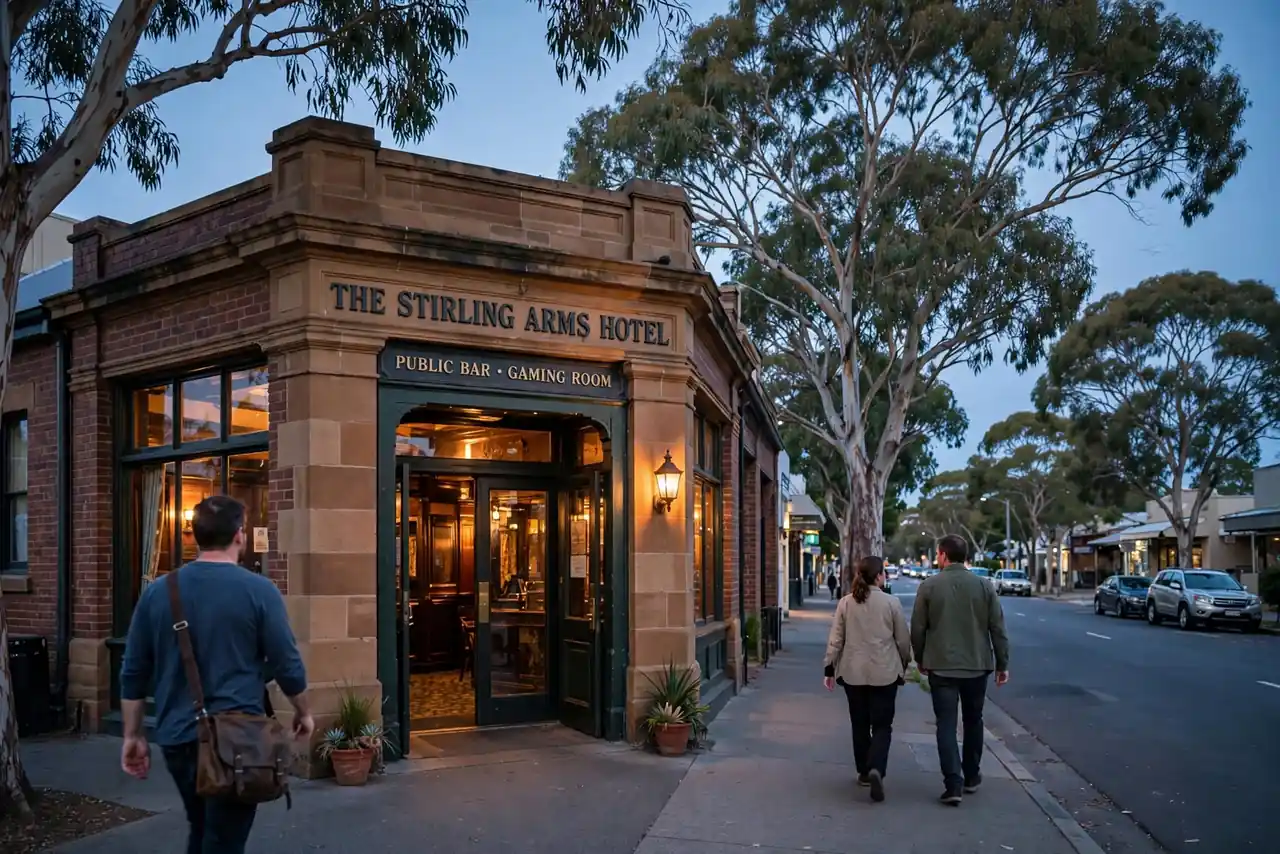
For North Melbourne, the useful distinction is between an address associated with the area and confirmed information about pokies at that address. South Melbourne requires the same separation. Combining the two into one city-wide list would not resolve the central issue: whether any named venue’s facilities have actually been established.
This matters because a location-based description can sound more definite than it is. “In North Melbourne” or “in South Melbourne” identifies geography, not the contents of a venue. Where machine availability is unconfirmed, a confident recommendation or ranking would add certainty that the location itself does not provide.
The responsible conclusion is narrow: these area names are not enough to identify a verified pokies venue. Any venue-specific statement should rest on current confirmation from that venue, rather than an assumption based on its address or a general description.
Are online pokies legal for Australian players?
Yes, Australian players are not the target of the Interactive Gambling Act’s prohibition and can play on offshore sites that accept them. However, no Australian-licensed online casinos exist, and players have no legal recourse in Australia if an offshore casino refuses to pay.
Can casinos change the RTP of their games?
Yes. Some game providers allow casinos to choose from multiple RTP settings for the same pokie, so its return percentage can differ between casinos.
What are the new gambling machine measures for pubs and clubs in the Riverina?
From 1 July, venues with more than 20 gaming machines must have a responsible gambling officer on duty while the machines are operating. Venues must also keep a register of gambling incidents; they have a one-month grace period to remove signage and introduce responsible gambling officers.
Prepared by the Oz2win Casino editorial staff.